
Quick answer: A buffer zone is a strip of land or a barrier that separates an organic plot from a neighbouring conventional field. It reduces the risk of pesticide drift and runoff. In smallholder settings, buffer zones can be hedges, grass strips or rows of other crops, and they are checked during organic inspections.
Key takeaways – Buffer zones protect organic plots from drift. – They can be hedges, grass strips or crop rows. – Width and type depend on local risk. – Internal and external inspectors check them.
Why buffer zones are needed
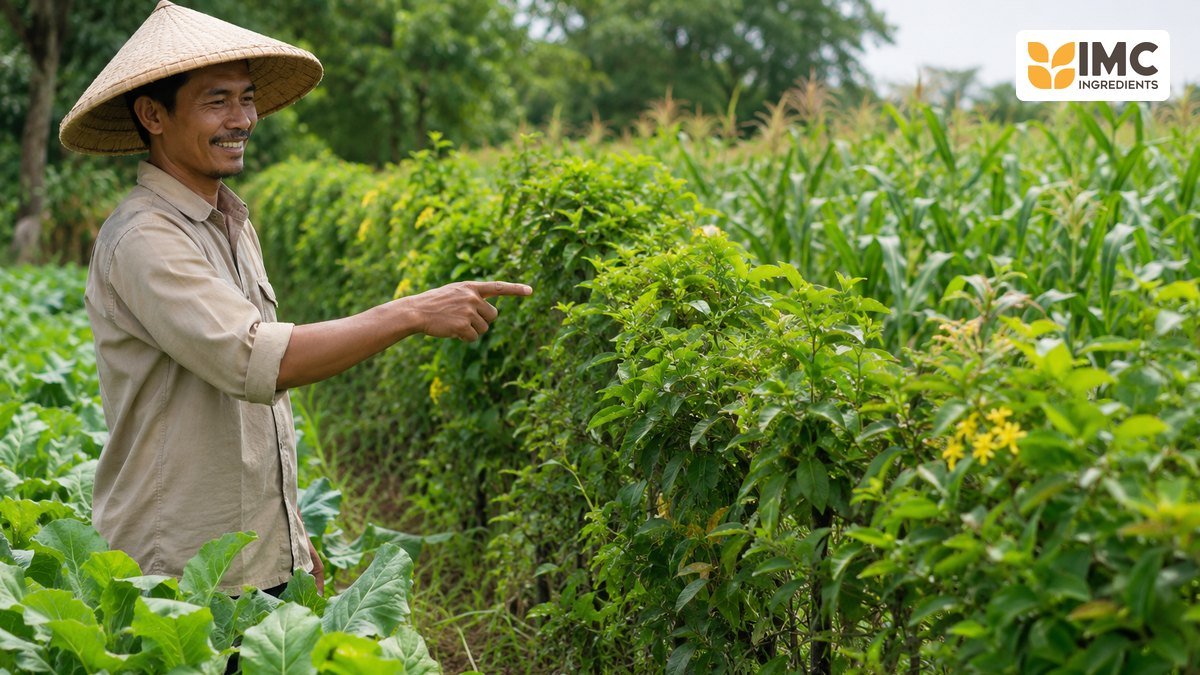
Smallholder farms are often small and close together. An organic farmer may have a neighbour who uses pesticides or synthetic fertilisers. Wind and rain can carry these substances across field borders. A buffer zone reduces this risk.
Types of buffers
| Buffer type | Description |
|---|---|
| Hedge | Dense plants that catch drift |
| Grass strip | Ground cover that slows runoff |
| Crop rows | Crops harvested as non-organic |
| Physical barrier | Walls, ditches or roads |
| Distance | Unplanted space between fields |
Setting up a buffer
- Map the farm and neighbouring fields.
- Identify where conventional inputs are used nearby.
- Choose a suitable buffer type.
- Plant or mark the buffer.
- Record the buffer on the farm map.
- Maintain it over time.
Harvest from buffer zones
Crops grown in buffer zones may not be sold as organic, depending on the standard and risk. Farmers and the internal control system must keep these products separate.
Talking with neighbours
Good relations help. Farmer groups can talk with neighbours about spraying times and wind direction. Some neighbours agree to avoid spraying near the border.
Inspections
Internal inspectors check buffers during farm visits. External inspectors from the control body review maps and visit a sample of farms. Problems are recorded and corrected.
Buffers and biodiversity
Hedges and grass strips can also provide habitat for beneficial insects and reduce soil erosion. This is a useful side effect, but the main purpose for certification is protection from contamination.
Updating buffers over time
Land use around organic farms can change. A neighbour may start or stop using pesticides, or a new road may be built. Farm maps and buffer plans should be reviewed each year and updated when needed.
Buffers in group certification
In group certification, the internal control system keeps a map of every member’s plots and notes where buffers are needed. New members are checked before they join, so the group knows about risks early and can plan buffers from the start.
Where does IMC fit?
PT Integral Mulia Cipta (IMC Group) has produced coconut sugar in Central Java, Indonesia, since 2012. IMC supplies organic coconut sugar in mesh 14 and mesh 50, and its GIZ develoPPP partnership since 2025 supports organic certification work with farmer groups.
FAQ
What is a buffer zone? A barrier or strip separating organic and conventional land.
How wide should it be? It depends on the standard and local risk.
Can buffer crops be sold as organic? Often not; they are kept separate.
Who checks buffer zones? Internal and external inspectors.
Looking for a reliable coconut sugar partner? Contact PT Integral Mulia Cipta (IMC Group) in Central Java, Indonesia: info@organic-coconut-sugar.com or WhatsApp +62 821 1348 5564.