
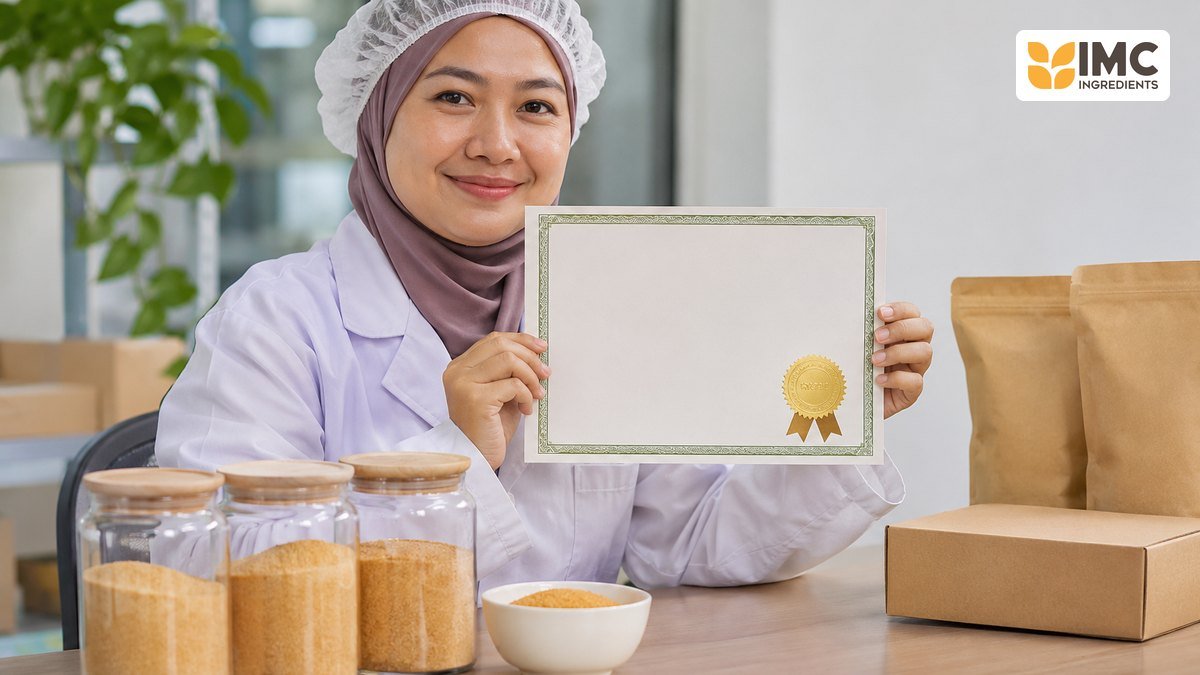
Quick answer: Before buying organic coconut sugar, check that the supplier’s organic certificate names the right company, covers the product and activity, is valid on the purchase date and is issued under the standard of your market. Verify the certificate in the official database where possible and check that each shipment has the correct transaction or import documents.
Key takeaways – Check holder name, scope, product and validity. – Make sure the standard matches your market. – Verify certificates in official databases. – Shipment documents are also required.
Why checking matters
Organic fraud and simple mistakes both happen. If a buyer uses a non-certified ingredient in an organic product, the buyer’s own certification can be at risk. A few minutes of checking can prevent big problems.
Certificate checklist
| Item | What to check |
|---|---|
| Certificate holder | Same as the seller or clearly linked |
| Address | Matches the production or trading site |
| Standard | EU, USDA or other relevant market |
| Products | Coconut sugar listed |
| Activities | Production, processing, export |
| Validity | Valid on purchase and shipment dates |
| Control body | Approved for that standard |
Verifying online
Many standards have official databases. For example, EU certificates are available in TRACES, and the USDA has an organic integrity database. Search for the supplier name and compare details.
Transaction and import documents
- EU imports need an electronic certificate of inspection.
- US imports need the required import certificate.
- Other markets have their own documents.
- Lot codes and weights must match the goods.
Red flags
- Certificate details that do not match the company.
- Expired or suspended certificates.
- Products not listed in the scope.
- Reluctance to share documents.
- Prices far below the market for organic product.
Keeping records
Store certificates with their dates and review them before each order. Set reminders for expiry dates. Keep shipment documents by lot.
Working with suppliers
Good suppliers share documents quickly and explain any changes. If something is unclear, ask questions early.
Multiple certificates
Some suppliers hold certificates for several standards, such as EU and USDA. Check that the certificate you rely on matches the market where your product will be sold. A certificate for one market does not automatically cover another.
Checking certificates for traders
If you buy through a trader or distributor, that company also needs suitable organic certification for its activity. Check the trader’s certificate as well as the producer’s. The chain of certificates should be complete from the producer to you.
Where does IMC fit?
PT Integral Mulia Cipta (IMC Group) has produced coconut sugar in Central Java, Indonesia, since 2012. IMC supplies organic coconut sugar in mesh 14 and mesh 50 and shares organic documents with buyers on request.
FAQ
Where can I verify an EU organic certificate? In the EU’s TRACES system.
Is the certificate alone enough? No, shipment documents are also needed.
What if the certificate has expired? Do not buy as organic until it is renewed.
What is a red flag? Details that do not match, or unusually low prices.
PT Integral Mulia Cipta (IMC Group) has produced organic coconut sugar in Central Java, Indonesia, since 2012. For specifications or samples, email info@organic-coconut-sugar.com or WhatsApp +62 821 1348 5564.