
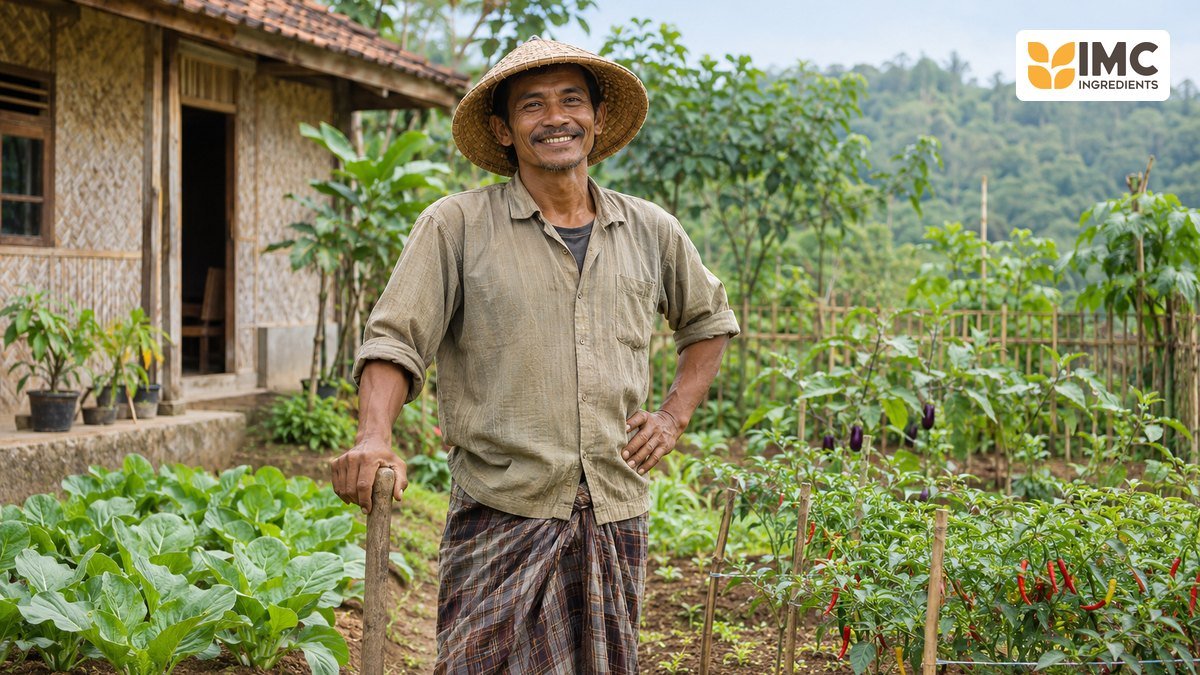
Quick answer: A smallholder is a farmer who works a small area of land, mostly with family labour, often growing several crops and sometimes raising animals. There is no single global size limit; definitions vary by country and organisation. In coconut sugar production, smallholders tap their own or local trees and often cook the sap at home.
Key takeaways – Smallholders farm small areas with family labour. – Definitions vary between countries and organisations. – Coconut sugar is mostly a smallholder product. – Smallholder supply needs specific support and planning.
Common features
| Feature | Description |
|---|---|
| Farm size | Small, often a few hectares or less |
| Labour | Mostly family members |
| Crops | Several crops for food and income |
| Market access | Often through groups or collectors |
| Resources | Limited capital and equipment |
Smallholders in coconut sugar
Coconut sugar is typically made by families who tap trees, collect sap and cook it into sugar. Each household produces relatively small amounts. Farmer groups or collectors bring these together for processing and export.
Strengths of smallholder supply
Smallholder supply spreads income across many families. Farmers know their land well and often use traditional practices. Group certification allows smallholders to access organic markets together.
Challenges
- Limited access to finance and tools.
- Exposure to price and weather changes.
- Safety risks in tapping tall trees.
- Difficulty meeting complex documentation demands.
- Ageing farmers and youth migration.
Support that helps
Training, tools, group organisation and fair, stable trading relationships help smallholders. IMC’s CSR includes a tool renewal programme with PUR Projet in 2023 and a GIZ develoPPP partnership since 2025 covering training, safer work, organic certification and dwarf coconut.
Why buyers should understand the term
Buyers increasingly report on their supply chains. Knowing that coconut sugar comes from many smallholders helps buyers set realistic expectations on volumes, documentation and timelines, and design support that fits.
Using the term carefully
When writing about smallholders, avoid generalisations or invented stories. Describe the specific context and use accurate information.
Smallholder groups and organic certification
Group certification allows many small farmers to be certified together under one internal control system. This lowers the cost per farmer and makes organic markets reachable. The group shares responsibility, so training and internal inspections are important for every member.
Smallholders and documentation
Buyers often ask for documents that are easy for a large farm but hard for a smallholder. Suppliers and farmer groups can bridge this gap by keeping group records on behalf of members.
Where does IMC fit?
PT Integral Mulia Cipta (IMC Group) has produced coconut sugar in Central Java, Indonesia, since 2012. IMC works with smallholder farmer groups and supplies organic and conventional coconut sugar in mesh 14 and mesh 50.
FAQ
Is there a fixed size for a smallholder? No, definitions vary.
Is coconut sugar a smallholder product? Mostly, yes.
How do smallholders access organic markets? Often through group certification.
What support helps smallholders? Training, tools, organisation and stable trade.
IMC Group (PT Integral Mulia Cipta) supplies fine-granule organic coconut sugar from Central Java to food companies worldwide. Talk to our team: info@organic-coconut-sugar.com or WhatsApp +62 821 1348 5564.