
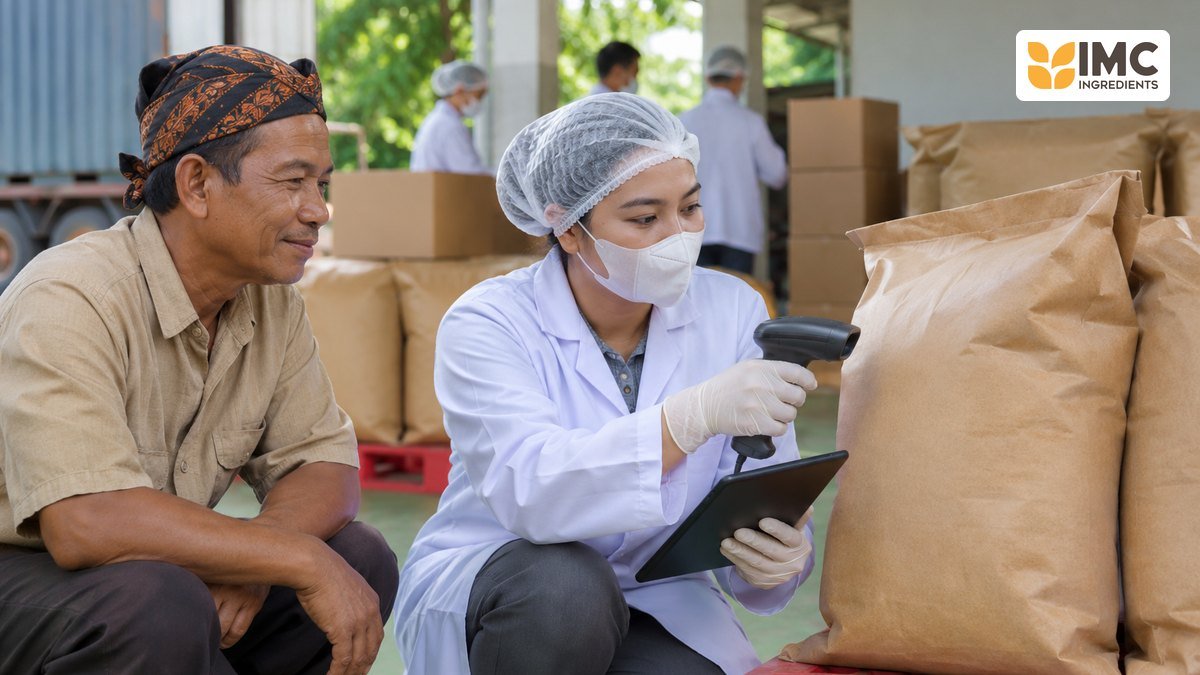
Quick answer: Traceability means being able to follow a product back to where it came from. For coconut sugar, this links each export bag’s lot code to the processing records and to the farmer groups that supplied the raw sugar. Clear records at collection, processing and packing make this possible and support organic integrity and quick answers to buyer questions.
Key takeaways – Traceability links bags to farmer groups. – Records are needed at every handover. – Lot codes connect documents and products. – Good traceability supports organic and quality checks.
Why traceability matters
Buyers need to know where their ingredients come from. Food safety rules require one step back and one step forward traceability. Organic rules require proof that the product comes from certified sources. Traceability also helps investigate complaints.
Steps in the chain
| Step | Record |
|---|---|
| Farmer production | Farmer list, group membership |
| Collection | Date, group, quantity, organic status |
| Receipt at factory | Incoming lot number |
| Processing | Drying, sieving, blending records |
| Packing | Finished lot code, quantity |
| Shipment | Container, lot codes, documents |
Smallholder groups
Many small farmers deliver to a collection point. Each delivery is weighed and recorded under the farmer group. For organic groups, the internal control system keeps the list of certified members.
Linking lots
When incoming lots are combined during processing, the factory records which incoming lots went into each finished lot. This creates the link from bag to group.
Testing traceability
- Pick a finished lot code.
- Trace back to incoming lots and groups.
- Trace forward to customers.
- Check timing and completeness.
- Record the test result.
Regular tests show whether the system works in practice.
Digital and paper records
Small operations may use paper forms at collection points and spreadsheets in the office. What matters is that records are complete, legible and stored safely.
Sharing information with buyers
Buyers may ask for traceability information during approval or audits. Suppliers can share the system description and test results while protecting farmers’ personal data.
Protecting farmers’ data
Farmer lists contain personal information such as names and locations. Store these lists securely and share only what buyers or auditors need. Summaries by group or region are often enough for buyer questions.
Where does IMC fit?
PT Integral Mulia Cipta (IMC Group) has produced coconut sugar in Central Java, Indonesia, since 2012. IMC works with farmer groups and supplies organic and conventional coconut sugar in mesh 14 and mesh 50 with lot coding on every bag.
FAQ
What is traceability? Following a product back to its source and forward to customers.
How are farmer groups linked to bags? Through collection records and lot codes.
How is traceability tested? By tracing a lot back and forward and checking records.
Can buyers see farmer data? They see system information; personal data is protected.
PT Integral Mulia Cipta (IMC Group) has produced organic coconut sugar in Central Java, Indonesia, since 2012. For specifications or samples, email info@organic-coconut-sugar.com or WhatsApp +62 821 1348 5564.