
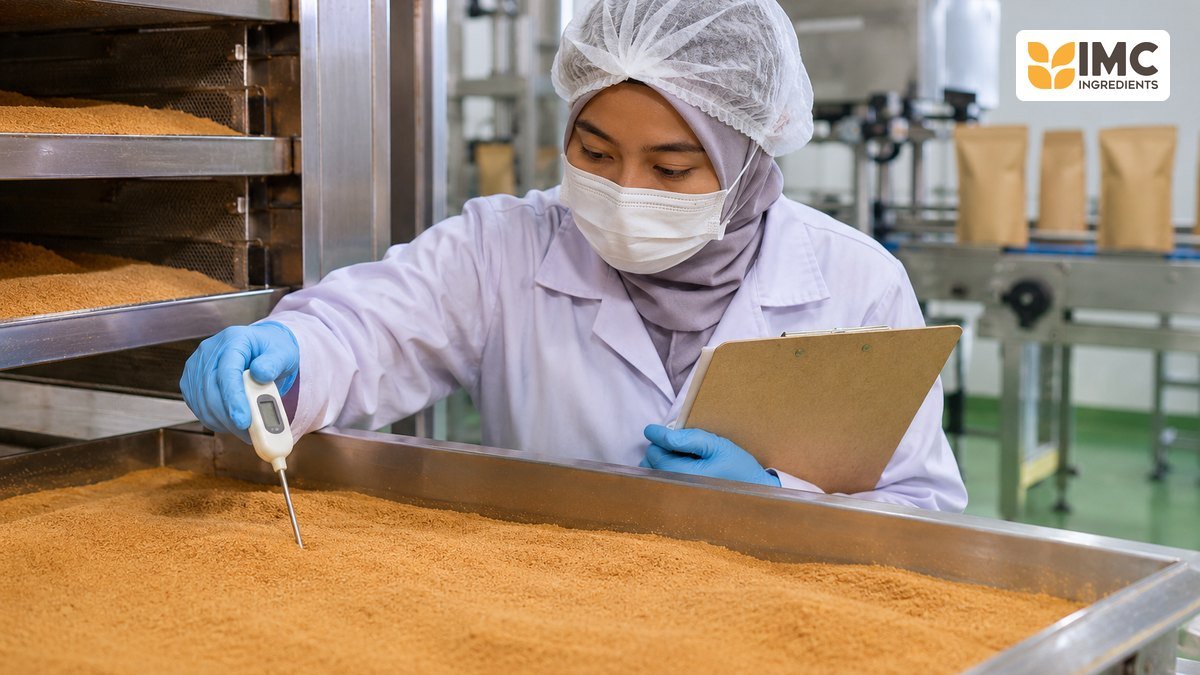
Quick answer: A critical control point (CCP) is a step where control is essential to prevent or reduce a food safety hazard to a safe level. In coconut sugar drying and packing, the hazard analysis usually focuses on physical hazards such as foreign matter and on moisture control. Which steps become CCPs depends on each factory’s own HACCP study.
Key takeaways – CCPs come from a site-specific HACCP study. – Foreign matter and moisture are key concerns. – Each CCP needs limits, monitoring and records. – Prerequisite programmes support CCPs.
HACCP in brief
HACCP stands for Hazard Analysis and Critical Control Points. A team lists hazards at each process step, decides which are significant and identifies where control is critical. Each CCP has a critical limit, monitoring, corrective action and records.
Possible hazards in drying and packing
| Step | Hazard type | Example |
|---|---|---|
| Drying | Microbiological | High moisture supporting growth |
| Sieving | Physical | Foreign matter passing through damaged screens |
| Metal detection (if used) | Physical | Metal fragments |
| Packing | Physical, microbiological | Contamination from open product |
Examples of controls
- Drying to a target moisture, checked by testing.
- Sieve screen checks before and after each shift.
- Metal detection with test pieces, where installed.
- Hygiene rules in the packing area.
- Sealed liners to protect product.
Critical limits
A critical limit is the value that separates safe from unsafe, for example an intact sieve screen or a working metal detector. Limits must be measurable and based on evidence.
Monitoring and records
Operators check each CCP at set intervals and record results. Supervisors review records daily. If a limit is not met, corrective action is taken and affected product is held.
Prerequisite programmes
Cleaning, pest control, staff hygiene and maintenance support the HACCP plan. Many risks are controlled through these programmes rather than CCPs.
Verification
Internal audits, record reviews and occasional testing confirm that the HACCP system works. The plan is reviewed when the process changes.
Training the HACCP team
The HACCP team should include people from production, quality and maintenance. Training helps them understand hazards and how to judge risks. A team that knows the process well produces a more useful plan than one written only by consultants.
Where does IMC fit?
PT Integral Mulia Cipta (IMC Group) has produced coconut sugar in Central Java, Indonesia, since 2012. IMC dries, sieves and packs organic and conventional coconut sugar in mesh 14 and mesh 50 in paper bags with a food-grade PE liner.
FAQ
What is a CCP? A step where control is essential for food safety.
Are CCPs the same in every factory? No, they come from each site’s HACCP study.
What happens if a limit is not met? Corrective action is taken and product is held.
What supports CCPs? Prerequisite programmes like cleaning and pest control.
PT Integral Mulia Cipta (IMC Group) has produced organic coconut sugar in Central Java, Indonesia, since 2012. For specifications or samples, email info@organic-coconut-sugar.com or WhatsApp +62 821 1348 5564.